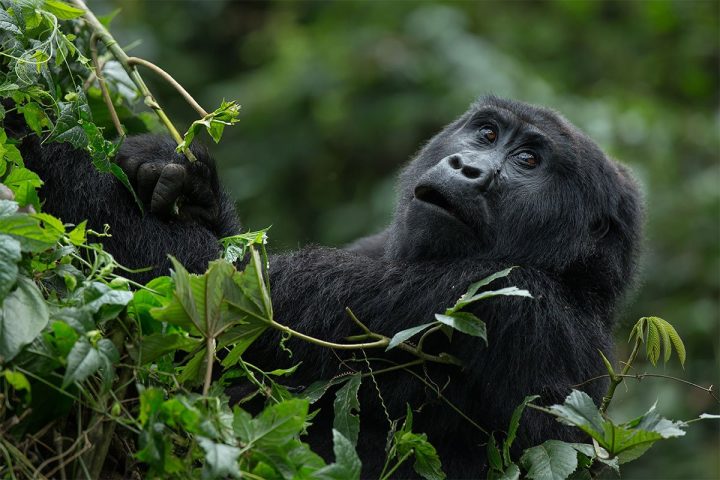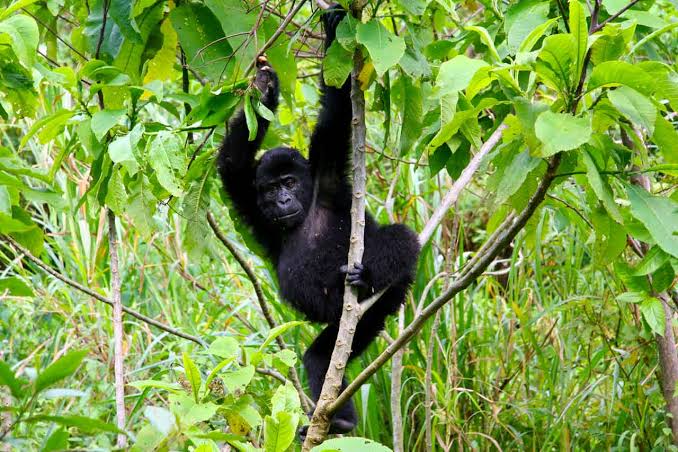

Eastern Lowland gorillas (Gorilla Beringei Graueri), also known as Grauer’s gorillas, are the largest of the four gorilla subspecies. They are found in the lowland and montane forests of the eastern Democratic Republic of the Congo (DRC). The Grauer’s gorilla is critically endangered as listed by the IUCN and is endemic to the montane forests of DRC in Kahuzi-Biega national park, and Maiko national park.
Eastern Lowland Gorillas are key ecosystem engineers, helping maintain forest biodiversity, and making conservation crucial to their survival and habitat health.
Eastern lowland gorillas are estimated to be 6,000 as their population declined drastically in the mid-1990s. They are still threatened due to deforestation, mining, poaching, and civil and armed conflict in the Democratic Republic of Congo.
As their name suggests, Eastern lowland gorillas inhabit lowland rainforests, and montane forests at an elevation of 2,600m (8,500ft). Weighing between 70-210kgs, males can grow up to 5.6 feet tall when standing and weigh between 180-210 kg.
Males have broad chests, muscular arms, and large hands making them stronger than females, however, they are generally gentle and protective unless threatened. Male eastern lowland gorillas develop a silverback patch on their backs once they reach maturity which is around 12-15 years.
Important decisions about movement, feeding locations, and conflict resolution are handled by the dominant silverback as the leader of the group that consists of multiple females, juveniles, and younger males. A dominant silverback has exclusive mating rights with the females of the group and plays an active role in protecting infants, though mothers are the primary caregivers.
Female eastern lowland gorillas weigh about 70-113kgs which makes them smaller than the males, however, females play a crucial role in their social groups through reproduction, and caring for their young ones. Females have thicker, dark brown fur, slender, and agile compared to males.
Much as they rely on the dominant silverbacks for protection, females handle grooming and social interactions which helps maintain group stability.
They are considered sexually mature at the age of 7-8 years but might give birth at 10 years with gestation lasting eight and a half months. As the primary caregivers, female gorillas will give birth every 4-6 years as their infants fully depend on them during that time frame.
Eastern lowland gorillas are primarily herbivorous, with a diet rich in plant material, however, this diet varies depending on their habitat and seasonal food availability. They eat a wide variety of wild fruits, leaves, sterns, bark, seeds, nuts, flowers, shoots, insects, and occasionally soil to absorb some minerals to neutralize the plant toxins. They will spend 4-6 hours per day foraging, and eating. They also rarely drink water as they survive off the water from food, especially the fruits, and leaves.
The average lifespan of an eastern lowland gorilla is 30 to 40 years in their natural habitat, and 50 to 60 years while in captivity, where they are protected from predators and have access to medical care. Diseases, injuries, and access to resources can impact how long a gorilla lives in the wilderness.
As critically endangered primates, eastern lowland gorillas’ numbers have declined rapidly due to several human-induced threats like logging, agriculture, and mining which is destroying their forest home; poaching and illegal trade which means that even in protected areas they are still vulnerable due to weak law enforcement; civil unrest and armed conflict as their home is used by many of these armed groups putting their lives at risk; diseases like Ebola and other respiratory infections which cause death due to their genetic similarity to humans; and climate change which alters the distribution of food sources plus increased droughts which disrupt ecosystems.
Efforts to protect eastern lowland gorillas include the creation of protected areas like Kahuzi-Biega and Maiko national parks, anti-poaching patrols and ranger support, community-based conservation projects, and banning illegal mining and logging in critical habitats.