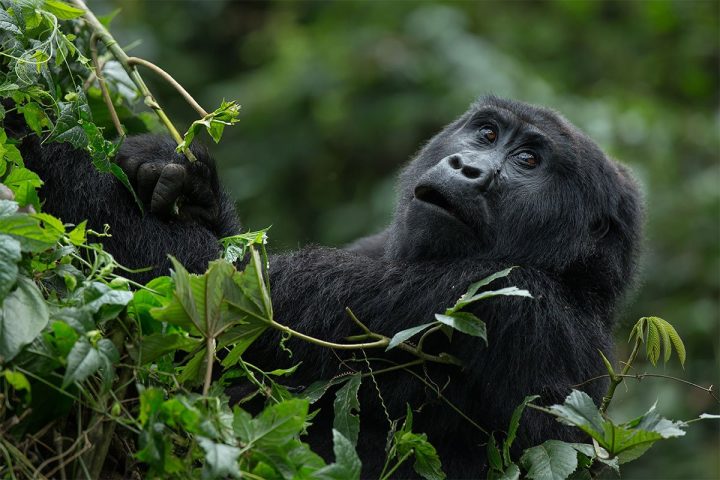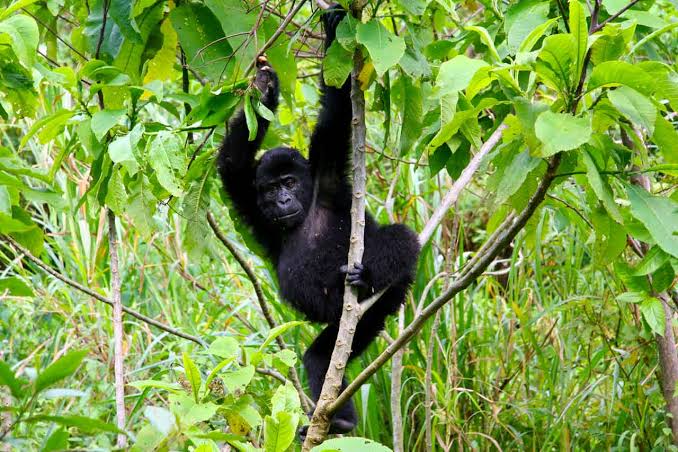
Mountain gorillas also known as Gorilla beringei beringei are a subspecies of the eastern gorilla and are found in only two regions in central and east Africa, the Virunga Mountains, the Bwindi Impenetrable Forest, and Mgahinga in Uganda. With over 1000 gorillas in the world, more than half of these magnificent creatures are situated in the Bwindi Impenetrable Conservation Area, and the smaller number in the Central part of Africa, mountain gorillas have been listed and considered endangered by the IUCN due to habitat loss and political instability. Much as their numbers are slowly increasing due to active conservation, mountain gorillas are still endangered; this growth is attributed to long-term protection measures, including regulated ecotourism, veterinary care, community involvement, and international support.
Mountain Gorillas (Gorilla Beringei) are found in Uganda and are more than half of the world’s population. Their name hints at their habitat as they live in mist-covered mountains at an elevation of 8,000-13,000ft with thick fur which comes in handy as it helps them survive by keeping them warm as the temperatures are often below freezing. This physical adaptation helps them survive in a climate that can be harsh and unpredictable. They are the only gorillas adapted to these cooler, high-altitude environments, often cloudy, damp, and densely forested.
Males will be bigger than the females with silver hair on their backs and large bumps on their heads called Sagittal Crests. This information however helps little in regards to the young males and females. Mountain gorillas live in families and share 98% of the human DNA with a weakness of slow speed and poor sight which means they can only run for short distances. Mountain gorillas live in stable family groups led by a dominant silverback male and the groups are peaceful, cohesive, and tightly bonded. Despite their size and strength, mountain gorillas are generally calm and non-aggressive unless provoked, something that has surprised many researchers and visitors.
Male mountain gorillas weigh between 140-200kgs and stand up to 1.7 meters when upright; at the age of 12, they develop a silver-gray saddle of hair on their backs marking their full maturity hence the term ‘silverback’. Males are significantly larger and more muscular than females, with broad chests, long arms, and large heads. A mature dominant silverback assumes the leadership role as the dominant silverback, keeps the group cohesive, and also has the best access to the females for mating; with the help of other male gorillas, they also provide protection for the family and mediate conflict. Not all adult males become group leaders, some remain subordinate within the group while others leave to form their own and are called blackbacks before they are silverbacks. Males normally separate from their original families at the age of 11, they will either go alone or go with other males and form another group until they are old enough to attract females of their own to increase the newly formed group or family.
Though less physically imposing than males, Females are essential to the survival, and continuity of gorilla populations through group structure, reproduction, and caring for the young. Adult females weigh between 90-115kgs which is smaller and less muscular than males and do not develop silver hair on their backs. Female gorillas are strong, and agile with long arms well suited for climbing, and climbing. Females bond with each other, however, their stronger bonds are often with the dominant silverback, who offers protection and stability. There is usually a subtle social hierarchy among females, often based on age or tenure within the group, but it’s less rigid than in males.
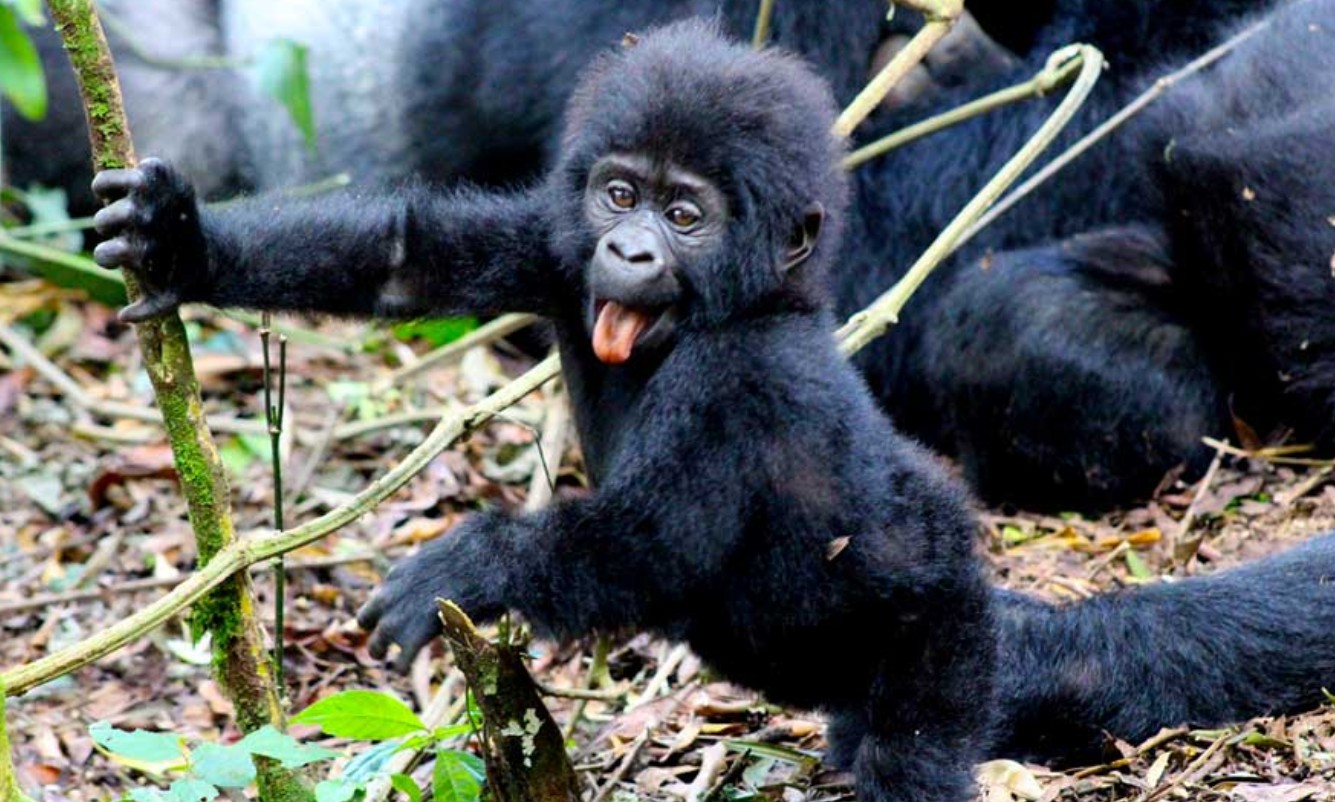
Females reach sexual maturity around 8-10 years of age with their first birth occurring around the age of 10 after a gestation period of eight and a half months. Newborns are highly dependent on their mothers, who carry them constantly for the first few months. The mother will nurse, carry, and protect her infant constantly during the early months and gradually encourage independence as the infant grows. If the infant survives, the female usually gives birth every 4 to 6 years but if the infant dies, she may conceive again sooner. Because of this slow reproductive rate, population recovery for mountain gorillas takes time, making each birth important for conservation. All this makes female mountain gorillas key to both the social and biological continuity of their groups.
The average lifespan of mountain gorillas in Uganda varies depending on whether they live in the wild or in captivity. Mountain gorillas can live to 35-40 years with good health, and protection which increases their chances of reaching old age. The lifespan of mountain gorillas is affected by factors like diseases, injury, poaching, intra-group conflict, habitat quality, and food availability.
Mountain gorillas are primarily herbivores, and their diet is made up almost entirely of plant material found in their forest habitats. The main components of their diet are leaves, shoots, fruits, bark, wood, roots, tubers, flowers, and rarely insects. Mountain gorillas spend most of their day feeding which is roughly 4-6 hours and rarely drink water as their diet provides ample moisture from the plants. Please note that mountain gorillas are selective feeders, often stripping off inedible parts and consuming only the most nutritious sections.
Mountain gorilla trekking can only be done with permits and these are documents issued by the Uganda Wildlife Authority to all visitors 15 years and above allowing them to visit the gorilla-habituated families. Gorilla trekking is done in Bwindi Impenetrable Forest and Mgahinga Gorilla National Park which two parks harbor more than half of the world’s mountain gorilla population. The prices of trekking are determined by a tourist’s nationality as residents and foreigners are costed differently.
Gorilla trekking for East African citizens is 300,000UGX per person, 700$ per person for foreign residents, and 800$ per person for foreign non-residents while those who would prefer spending more time with the magnificent gorillas will pay 750,000UGX for East African citizens, 1,000$ for foreign residents and 1,500$ for foreign non-residents per person. This money is to be paid through a trusted operator like Omangwa Safaris. Once the availability of the dates desired by the tourists is confirmed, a deposit is made to secure the slot desired and this has to be done at least 3 months before the desired dates. The permit covers entrance to the park, trekking, experienced guides, and rangers to ensure safety for both you and the primates.